Lebanon's Agricultural Sector Faces Catastrophic Damage From Ongoing Conflict
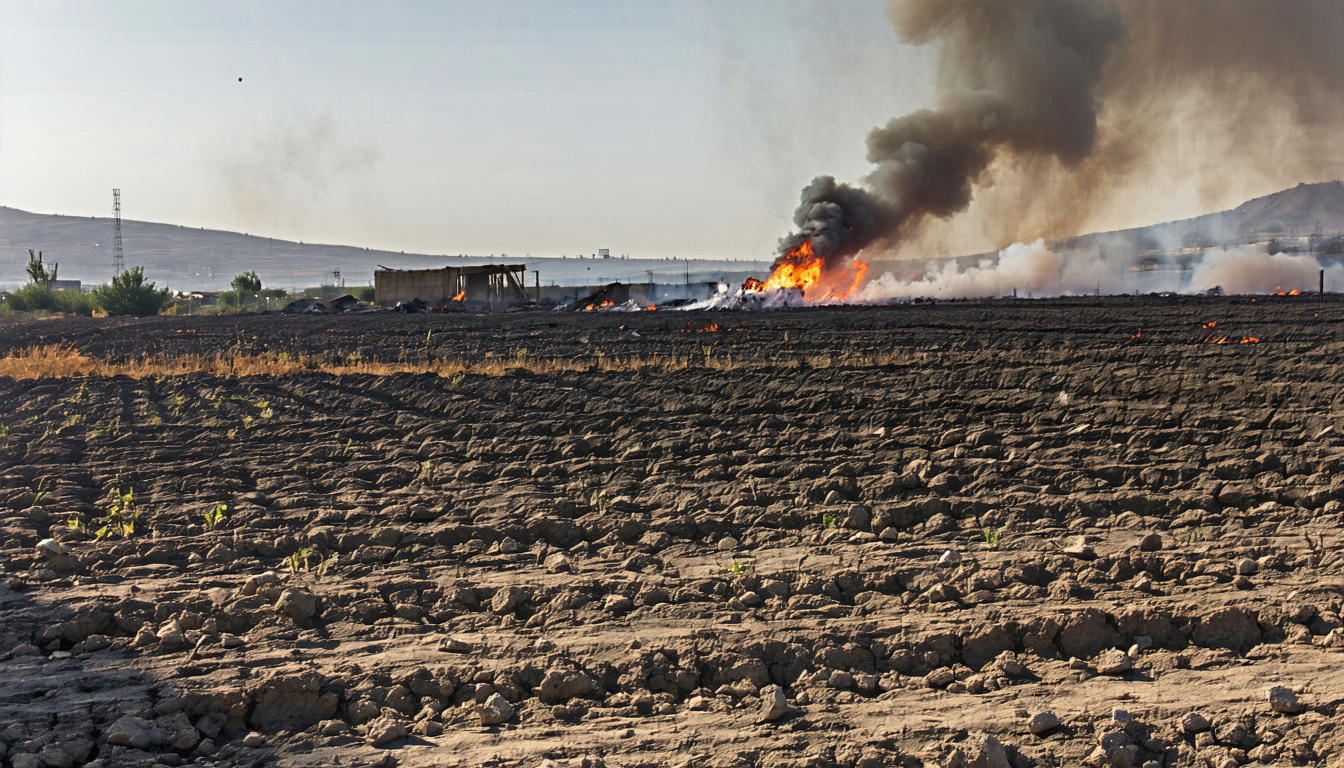
The ongoing military conflict has inflicted substantial damage on Lebanon's agricultural foundation, a sector already vulnerable to economic pressures. As military operations have intensified and displaced populations have moved across the country, the disruption has extended well beyond the southern regions, creating a widening threat to the nation's food security.
Data released in the Ministry of Agriculture's fourth response plan report on May 5, 2026, reveals that agricultural damage has affected approximately 56,000 hectares of farmland—roughly 22.5% of Lebanon's total agricultural land. Within the directly contested zones of the south, damage spans 18,000 hectares across 64 towns currently under military assault and destruction.
The scope of destruction extends beyond mere acreage. The conflict has devastated crops and trees that form the backbone of southern Lebanese agriculture and culture: olive groves, citrus orchards, banana plantations, and small family holdings. These are not temporary crops but rather foundational elements of the region's economic, social, and cultural fabric.
Border communities have seen agriculture become nearly impossible to practice. Farmers lack regular access to their fields, while fundamental operations—plowing, irrigation, harvesting, packaging, and transport—have been severely disrupted, fracturing the agricultural production cycle.
The damage assessments stem from multiple sources: government evaluations alongside research from the Food and Agriculture Organization, the National Council for Scientific Research, and the World Food Program. These organizations conducted field surveys and technical analyses to measure agricultural losses and their consequences for food security and rural livelihoods.
Rapid damage surveys documented the destruction of hundreds of greenhouses and agricultural facilities, along with massive livestock and poultry losses, decimated beehives, and damaged fish resources. These losses have crippled local food production and devastated the livelihoods of thousands of rural families.
Preliminary assessments place productivity losses at over $530 million, with direct material damages reaching $41 million. More troubling still, production losses substantially exceed the monetary value of physical damage itself—a consequence of blocked land access, halted agricultural operations, elevated energy and transportation expenses, and fractured supply and distribution networks.
The conflict has struck every link in the agricultural chain: from seeds and water supplies through to harvest, storage, marketing, and international sales.
As displacement accelerated beginning in March, Lebanon entered a more precarious phase regarding food security. Approximately 1.24 million individuals may experience severe acute food insecurity between April and August 2026, according to international classification systems. This coincides with dramatic increases in food and fuel costs.
March alone witnessed a 6% surge in the cost of a minimum food survival basket. Gasoline prices climbed 41%, diesel fuel jumped 83%, and cooking gas increased 27% between mid-February and mid-April. These increases have eroded purchasing power for Lebanese households and dramatically raised production costs for farmers.
The crisis has transcended conflict zones. Areas sheltering displaced populations now face food insecurity, as thousands of families relying on agriculture as their primary income source struggle to survive. The percentage of Lebanese requiring food assistance has climbed from approximately 18% to roughly 24% of the population—a troubling sign that the agricultural emergency has evolved into a comprehensive livelihood and social crisis.
The Ministry of Agriculture, partnering with international and local organizations, has shifted focus from emergency response toward structured coordination. The Agriculture Partners Network now serves as a coordination hub uniting donors, international agencies, local bodies, and private sector actors to synchronize assistance and ensure support reaches the most affected farming communities.
A unified digital platform and information database have been developed jointly with the National Council for Scientific Research and the Food Security Sector. This system enables continuous field data collection and analysis, facilitating priority-setting based on accurate information.
Through this network, farmers have received cash transfers and material assistance, including irrigation support, solar energy systems, animal feed, agricultural supplies, and infrastructure repairs—measures aimed at preventing the complete collapse of remaining agricultural capacity.
Yet a fundamental question persists: Can Lebanese agriculture endure a prolonged conflict of this magnitude?
Agriculture now represents a critical link to food security, national resilience, and social stability. In a nation already teetering on the edge of systemic failure, Lebanon's farmland faces its own existential struggle.
Compare options


